


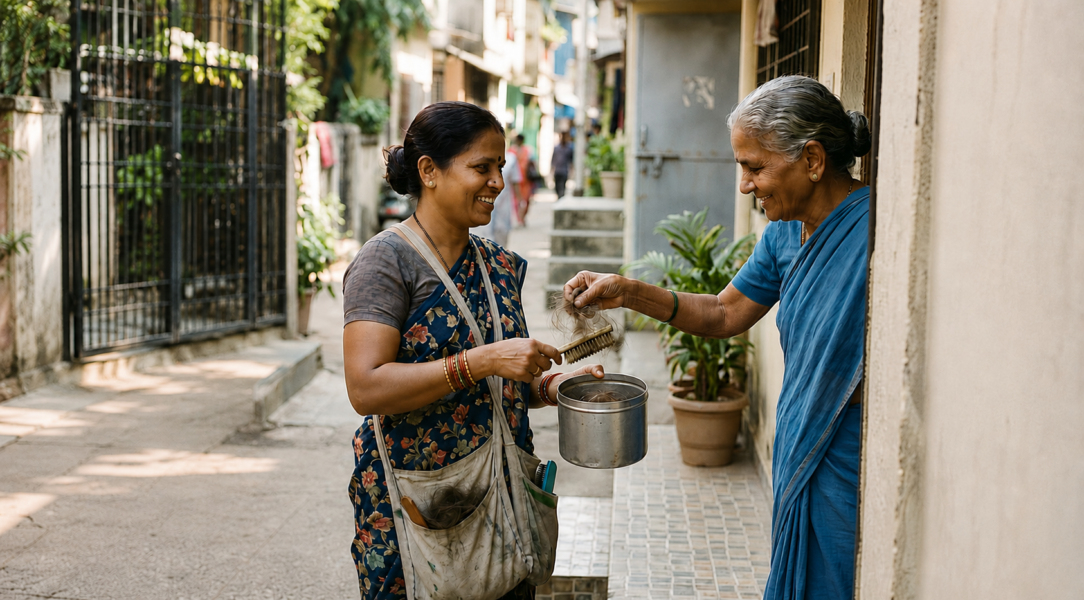
Every morning, we lose a little bit of hair. Some of it stays on our combs. Some fall on the bathroom floor. Some get swept away with the dust and disappear into the bin.
For most of us, that is where the story ends. For a hair picker, it is where the story begins.
Hair pickers are a subset of waste pickers who specialise in collecting discarded human hair from households, streets, salons, and religious spaces. This is a livelihood built on skill, patience, and generational knowledge of sorting and grading hair. In return, they may receive cash, kitchen utensils or hair clips. The hair is then sorted by colour, length, and quality, and sold for recycling eventually finding its way into products such as wigs and hair extensions.
It sounds like a simple livelihood. But finding enough hair to make a living is becoming harder.
A few years ago, a hair picker could collect around 500 grams in three days. Today, some spend an entire week moving around the city and struggle to find even 200 grams.
When the city changes, livelihoods change too
The way we live in our cities has changed.
Homes that once had open doors and familiar neighbourhood relationships are increasingly becoming apartment complexes and gated communities. For hair pickers, this has made something as basic as accessing households much more difficult.
Building a livelihood from collecting hair depends on relationships. A hair picker needs to know which homes they can visit, build trust with residents and return regularly. But when independent homes become large gated communities, access becomes restricted.
Women hair pickers face an additional challenge. Household responsibilities and safety concerns often mean they cannot travel as far or stay away from home for long periods. Men may travel to other districts and spend longer periods collecting hair, which gives them access to a larger area and, consequently, more hair.
So, the problem isn’t simply that there is less hair.
It is also about who gets access to it.
Hair is not just waste
We rarely think of hair as a resource.
Once it has fallen out of a comb or been cut at a salon, we usually consider it waste. But discarded hair has a market. Depending on its length, colour and quality, it can be sorted and sold for further processing and used in wigs and hair extensions.
For the person collecting it, that handful of hair has value.
This is why separating hair from other household waste matters. When hair is mixed with food waste, dust and other discarded materials, it becomes difficult to recover. When it is kept separately, it can enter a value chain and reach the people whose livelihoods depend on collecting it.
At our sister organisation, Hasiru Dala, we have been working to make that connection stronger.
In 2022, Hasiru Dala identified 593 hair pickers in Bengaluru. By 2025, almost 7,000 hair pickers had been mapped across Karnataka. Hair picking is not simply a source of income for these workers; it is also a skill that has been passed down through generations.
From collecting hair to building an enterprise
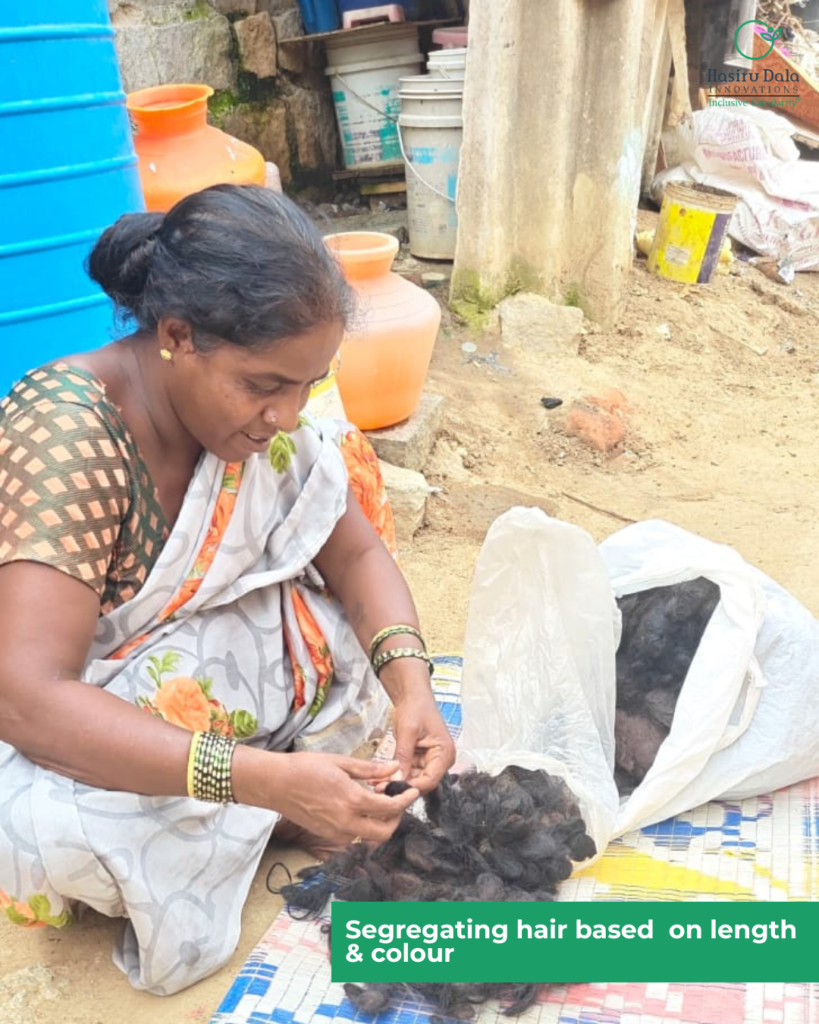
Our work with hair pickers is not limited to identifying them.
We are also looking at how they can participate more meaningfully in the value chain.
One example is Ratnamma, a hair picker who received seed funding and a weighing machine. With this support, she was able to strengthen her own work and extend micro-loans to other women involved in hair collection, creating a small supply chain around the livelihood.
This is what happens when we look at waste differently.
It stops being only about collection and management. It becomes about livelihoods, entrepreneurship and access to markets.
What can we do differently?
The simplest place to start is at home.
Instead of throwing hair into the general waste bin, keep it separately. A small change in how we drop off something can determine whether it becomes a resource or simply ends up as waste.
We have also been working with communities to make this easier.
Awareness campaigns have helped people understand the connection between hair disposal and the livelihoods of hair pickers. At Hasiru Dala’s office, hair is collected separately. In Davangere, community sessions, including sessions in women’s hostels, have introduced people to the idea of treating discarded hair as a resource. Collection bins have also been distributed and hostels connected with women entrepreneurs involved in hair collection.
These may seem like small actions.
But waste systems are built from small actions repeated by many people.
The next time you find hair in your comb, don’t immediately throw it away. Put it aside.
Because what looks like a few strands of hair to you could be part of someone’s livelihood.
And somewhere in the city, there may be a hair picker waiting to collect it, sort it and sell it, not because hair is simply “waste”, but because it still has value.
Sometimes, creating a more responsible waste system begins with noticing what we have been throwing away without thinking.
Want to contribute your hair for recycling?
You can reach out for pickup or send it directly:
Contact: Mala – +91 76191 40785
Address: Mala W/O Seena.TC Palya, Behind Meenakshi Temple, Brindavan Layout, KR Puram, Bengaluru – 560036