Large live events are designed to create unforgettable experiences. Thousands of people gather. Food is served. Merchandise is sold. Temporary infrastructure comes up overnight. And behind the scenes, waste accumulates rapidly.
At most events, mixed waste is treated as an unavoidable outcome. At the Linkin Park Bengaluru Concert 2026, it became an opportunity.
For March 4, 2026 concert in Bengaluru, the organisers partnered with Hasiru Dala Innovations to design and execute a decentralised waste management system that prioritised source segregation, material recovery, and circular processing.
This was not simply a clean-up operation after the event. It was a planned, end-to-end waste management system designed before the first attendee entered the venue.
Through structured segregation, trained on-ground teams, and clearly defined recovery pathways, the concert achieved 99% diversion from landfill.
Large-scale concerts generate multiple waste streams in a short period of time:
Without a planned system:
The Linkin Park Bengaluru Concert required a system that could respond to high volumes, multiple material streams, and fast turnaround timelines while maintaining environmental accountability.
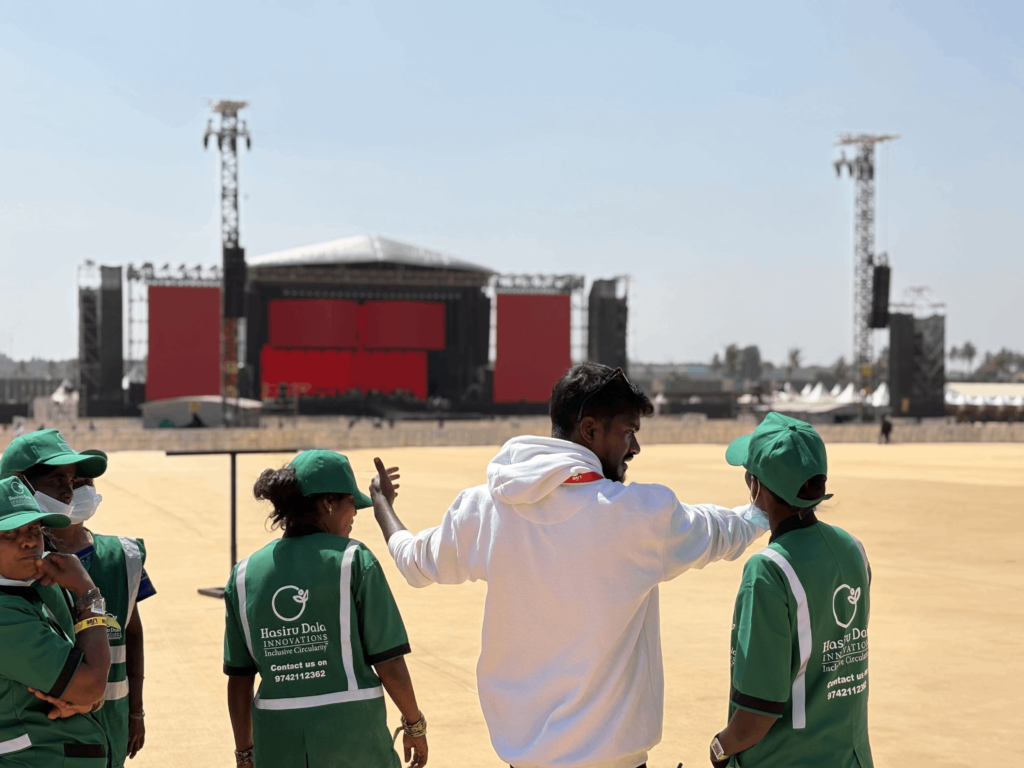
Segregation was embedded into the event from the beginning through dedicated collection systems and stream-wise handling.
Waste was separated into:
This ensured that each material stream could be directed into the most suitable recovery pathway rather than being disposed of as mixed waste.
Every category of waste generated at the event was processed through a defined circular pathway.
Wet Waste
Food waste generated at the venue was sent to Hasiru Dala Innovations’ biogas facility, where it was anaerobically digested to produce:
Garden Waste
Garden waste from the venue was sent for composting, and the resulting compost was donated to farmers.
Dry Waste
Dry waste was carefully sorted and channelled into specialised recycling streams:
Only the small fraction of waste that could not be recovered was sent to an authorised scientific landfill.
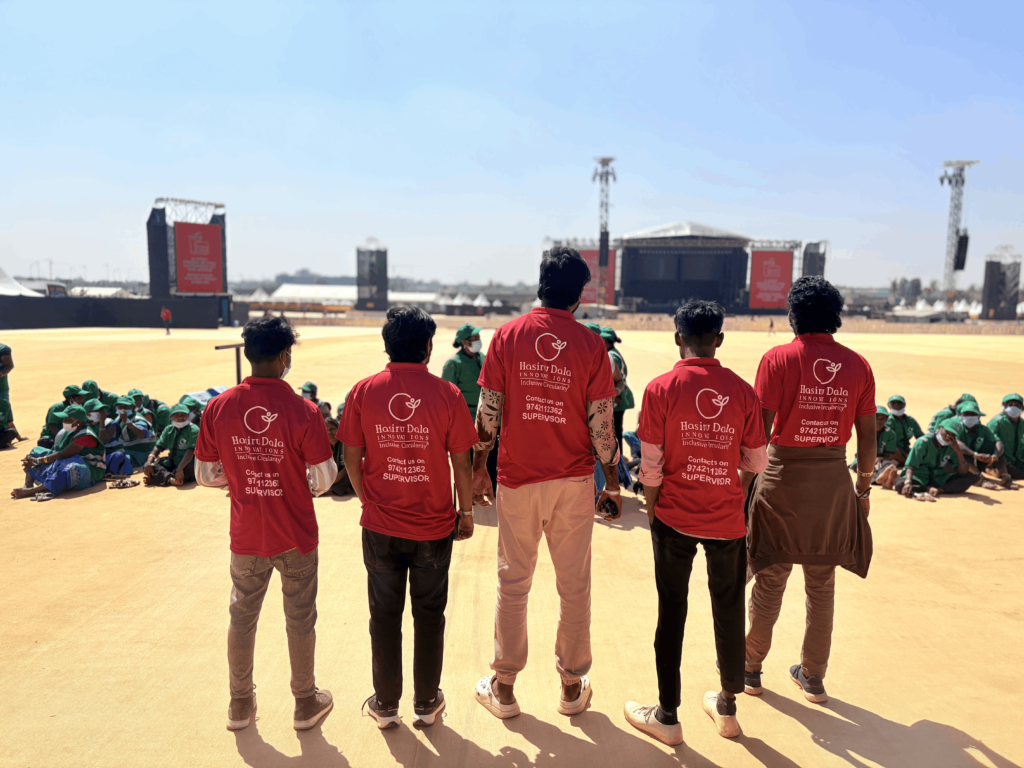
14,671 kg of waste generated during the event was processed through structured recovery systems.
Waste Stream | Quantity |
Wet Waste | 1,630 kg |
Garden Waste | 52 kg |
PET Bottles | 740 kg |
Plastic Waste, Trays, Covers & Wrappers | 2,549 kg |
Cardboard | 841 kg |
Thermocol | 32 kg |
Carpet | 2,420 kg |
Metal | 567 kg |
Paper Waste, Cups & Tissue | 3,660 kg |
Glass Bottles | 466 kg |
Cloth Waste | 230 kg |
Branding Flex | 918 kg |
Ribbons & Caution Tape | 35 kg |
Mixed E-Waste | 28 kg |
Wood | 93 kg |
Reject Waste | 205 kg |
Mode of Diversion | Quantity |
Recycled | 9,836 kg |
Reused | 2,650 kg |
Composted | 1,682 kg |
Co-processed | 298 kg |
Landfilled | 205 kg |
99% of Waste Diverted From Landfill
The event achieved:
This demonstrates that even high-footfall, temporary events can operate within a circular waste model when systems are designed in advance.
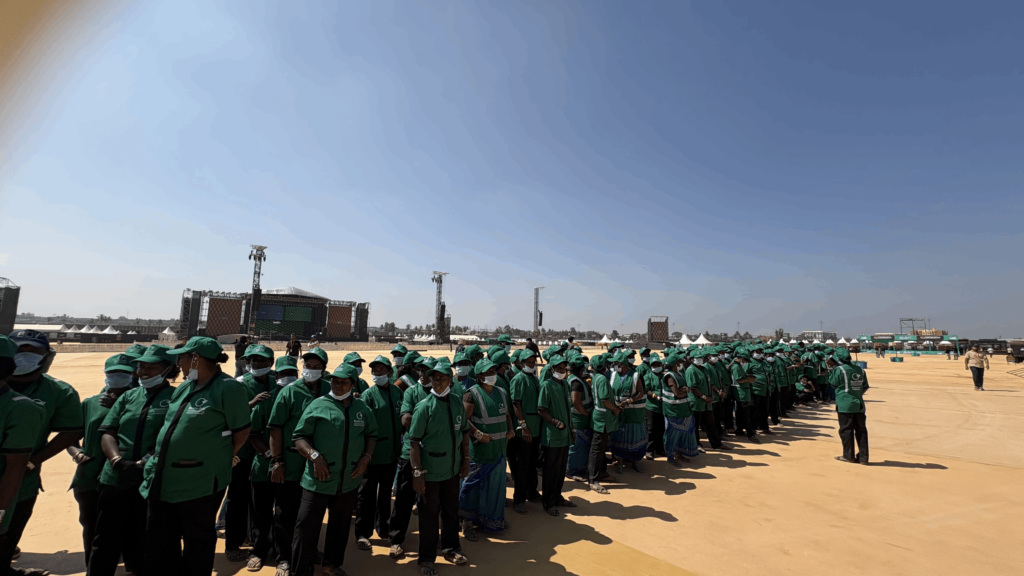
The waste management system created measurable environmental benefits:
This is equivalent to:
The event also prevented the equivalent of:
Beyond environmental performance, the event created direct social value.
Hasiru Dala Innovations’ model is rooted in Inclusive Circularity™ — ensuring that waste pickers and front-line workers are not excluded from the circular economy, but become an integral part of it.
The Linkin Park Bengaluru Concert contributed to:
The system transformed waste workers into trained green-collar professionals, creating dignified and predictable livelihoods while delivering measurable environmental outcomes.
Events often measure success by attendance, ticket sales, and audience experience. But the real test of sustainability lies in what happens after the crowd leaves.
The Linkin Park Bengaluru Concert demonstrates that waste management at events does not need to end in overflowing bins and landfill trucks.
When waste is treated as infrastructure rather than an afterthought, large-scale events can:
The differentiator is not awareness alone. It is systems thinking, planning, and operational discipline.
If your organisation is planning a concert, festival, exhibition, sporting event, or large public gathering, there is an opportunity to move beyond basic clean-up contracts and build a circular event model.
Partner with Hasiru Dala Innovations to create events that deliver:
Let’s design events where nothing goes to waste, and every material becomes an opportunity.
Got something on your mind?
Fill out the form and we will get back to you.


Copyright © 2025 Hasiru Dala Innovations. All rights reserved