

On this page
Quick answer
Under the Solid Waste Management Rules, 2026, in force from 1 April 2026, bulk waste generators must manage their own waste. They must register on the CPCB portal, segregate waste into four streams, process wet waste on site or through an Authorised Waste Processor, hold an EBWGR certificate and file annual returns by 30 June.
Key takeaways
- You're a bulk waste generator if you have 20,000 sq.m+ built-up area, use 40,000+ litres of water a day, generate 100+ kg of waste a day, or (in Bengaluru) have more than 100 households.
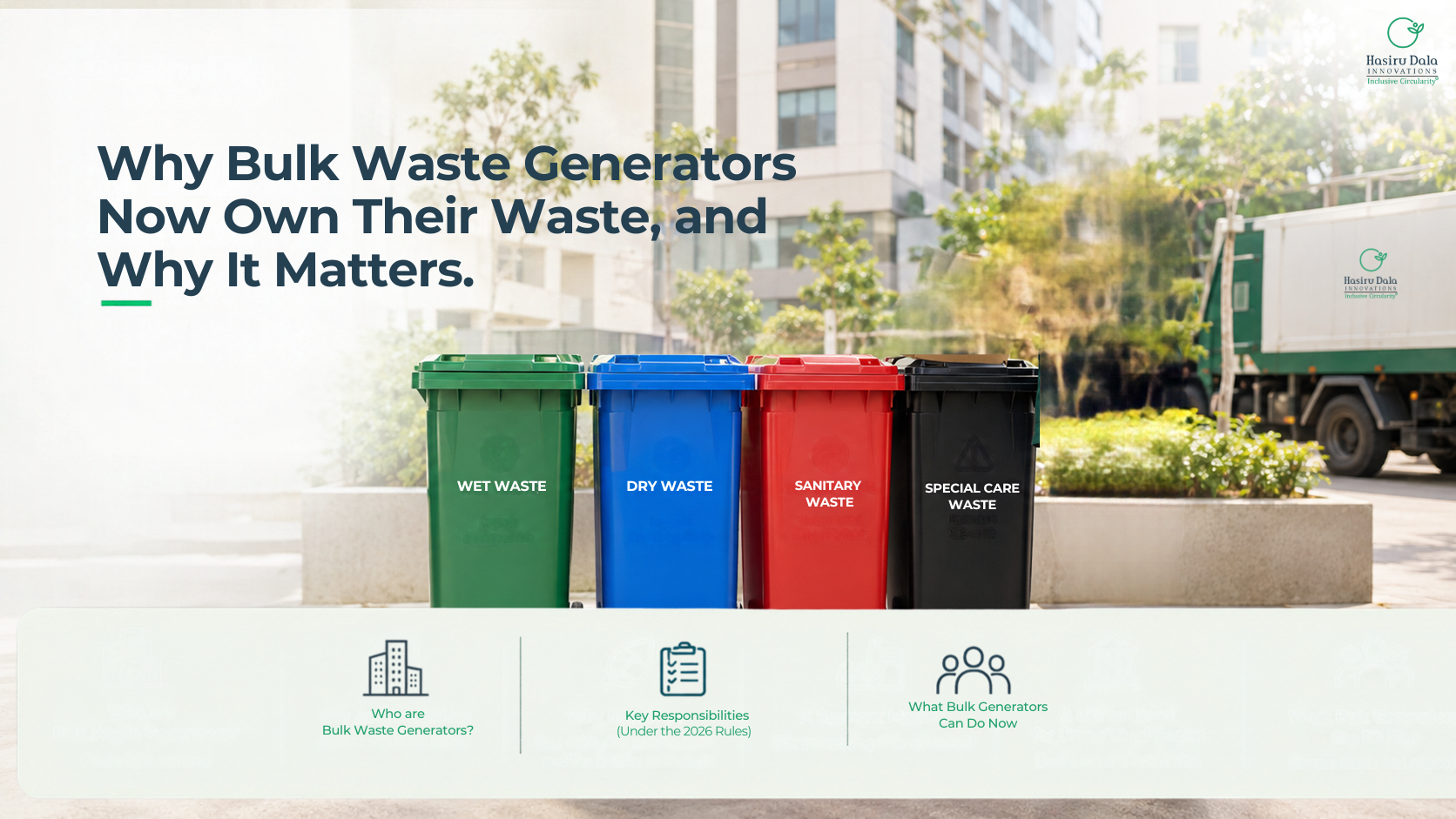
- The four streams are wet, dry, sanitary and special care waste.
- EBWGR certificates are issued by the local body and are valid for three years.
- Bulk generators produce close to 30% of urban India's solid waste, so regulating them first cuts the load on city systems.
- Predictable, measured demand and cleaner feedstock make waste processing attractive to private investment.
For decades, the waste from a 400-flat apartment complex or a tech park with 10,000 employees went into the same municipal system as the waste from a small shop down the road. The city collected it, transported it and often dumped it. The generator paid little beyond property tax. That arrangement has formally ended.
The Solid Waste Management Rules, 2026, notified by the Ministry of Environment, Forest and Climate Change on 27 January 2026 and in force since 1 April 2026, replace the 2016 Rules. In my view, the most consequential changes are 4-way segregation at source and Extended Bulk Waste Generator Responsibility (EBWGR). The revised rules integrate the principles of Circular Economy and Extended Producer Responsibility, with a specific focus on efficient waste segregation and management, which is in line with our ethos of Inclusive Circularity®
A Bulk Waste Generator (BWG) is any entity meeting one of the following:
- has a built-up floor area of 20,000 sq.m or more,
- water consumption of 40,000 litres a day or more,
- waste generation of 100 kg a day or more.
- a complex with more than 100 households (added in Bengaluru)
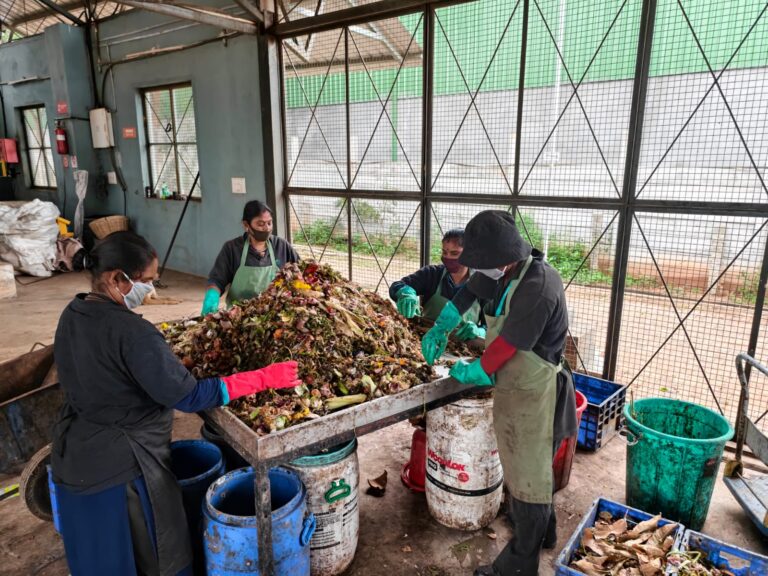
That covers apartment complexes, tech parks, corporate campuses, colleges, hotels, hospitals and government offices. A mid-sized apartment complex crosses the 100 kg threshold easily. Every Bulk Waste Generator must now process its wet waste on site or give it to an Authorised Waste Processor (AWP) who has been empanelled by the local bodies.
The obligations under EBWGR include:
- Registration: Bulk Waste Generators must register on the CPCB’s centralised online portal (https://swm.cpcb.gov.in/)
- 4 way at source segregation: mandates waste segregation at source into 4 streams:
- Wet waste: Organic, biodegradable like kitchen/food waste
- Dry waste: Inorganic, non-biodegradable like paper, plastic, metal
- Sanitary waste: Waste contaminated with bodily fluids/blood like used sanitary pads, diapers, bloodied bandages
- Special care waste: Hazardous waste that needs special care like pesticide/paint containers, CFL bulbs, batteries, small electronic items
- Wet waste: They must process wet waste on-site as far as possible or if unviable for any reason give it to an Authorised Waste Processor (AWP) who provides the data to obtain an EBWGR certificate from the Urban Local Body.
- Certificates: EBWGR certificates are issued by local bodies and are valid for three years.
- Returns: They must file annual returns by 30th June each year.
Why carve out bulk generators?
I see five reasons.
1. Concentration
Bulk Waste Generators generate close to 30% of urban India’s solid waste. They are a small, identifiable set of entities. A city can register, track and audit a few thousand bulk generators. It cannot do the same with lakhs of households and small shops. Regulating the concentrated end first is simply efficient.
2. Capacity to pay and to organise
Most Bulk Waste Generators have an association, a managing committee or a facility management team, and a budget. The polluter-pays principle is easy to state and hard to enforce. Here it can be enforced, because the payer is known and organised and has the ability to pay for responsible waste management.
3. Municipal systems are overwhelmed
India generates about 5.56 crore tonnes of solid waste a year, and roughly 46% of it ends up untreated. Every tonne of Bulk Waste Generator (BWG) waste handled outside the municipal stream reduces the load on the ULB infrastructure.
4. Wet waste is the real problem
Organic waste in a dumpsite produces methane, leachate and fires. Processing it in-situ or through the plant of an AWP ensures diversion from landfill, lowers strain on ULB infrastructure and ensures resource generation through bio-gas or composting.
5. Traceability
Bulk Waste Generators (BWG) must register on a centralised online portal, file annual returns by 30 June, and deal only with registered and authorised entities. Violations attract environmental compensation. For the first time, waste does not simply disappear once it leaves the gate. The Supreme Court has recently reinforced the same principle: responsibility for waste begins with the person or institution that generates it.
https://greensutra.in/news/solid-waste-management-rules-2026-all-you-need-to-know/
Taken together, the rules move India from a collection-centric system to one built on segregation, processing and accountability. The Bulk Waste Generator (BWG) carve-out is where that shift starts.
A market for processing capacity, and a lighter load for the city
For years, the weakest link in Indian waste management has been processing. Collection improved in most cities. Processing did not keep pace. Private investors stayed away for good reason. A processing plant depended on a single municipal contract, delayed payments and unsegregated feedstock of unpredictable quality. Few investors or lenders will finance a plant on those terms.
The 2026 Rules change the economics in four ways.
- Assured, measurable demand. Every Bulk Waste Generator (BWG) that cannot process wet waste on site must account for every kilogram through EBWGR certificates, issued by the local body on a central portal. The obligation is set by law, measured in kilograms and renewed every year. That is the kind of demand visibility an investor or lender looks for before financing a plant.
- Better feedstock. Four-stream segregation at source means processors receive for example cleaner wet waste. For a biogas plant, contamination is one of the biggest operating costs (eg. plastics and grit in organic feed damage pumps and digesters and bring down gas yield). Clean feed improves plant economics directly.
- Faster access to land. The Rules set graded criteria for faster land allocation to waste processing units. In my experience, land is often the longest delay in any waste project.
- A destination for every stream. Landfills are now restricted to non-recyclable, inert waste, with higher fees for unsegregated waste. Refuse-derived fuel is promoted as a substitute for fossil fuels in cement kilns. When dumping costs more and every stream has a buyer, investment in recovery and processing starts to make commercial sense.
Taken together, these provisions turn waste processing from a contract-dependent business into a regulated market with predictable volumes. That is what brings private capital in.
How this makes the urban local body’s job easier
Under the 2016 Rules, urban local bodies (ULBs) carried nearly the entire burden. They collected, transported, processed and disposed of waste, and were also expected to enforce the rules, usually with limited budgets and staff. Generators faced almost no consequence.
The 2026 framework allows the ULB to step back from running everything. The roles are now divided:
- The generator segregates and pays.
- The private processor invests in and operates the plant.
- The ULB registers, certifies, audits and penalises.
The practical benefits for the ULB are significant:
- Fewer trucks and trips, since Bulk Waste Generator (BWG) wet waste is processed on site or goes directly to a registered processor.
- Less landfill space needed, and lower spending on transport and dumping.
- Capital for processing comes from private balance sheets rather than the municipal budget.
- A digital portal replaces paper records, which makes monitoring faster and harder to manipulate.
- Environmental compensation gives the ULB a real enforcement tool, based on the polluter pays principle.
Most importantly, the ULB can concentrate its own limited resources on areas which only they could do: households, small shops, street sweeping and the remediation of legacy dumpsites. A city that no longer has to collect and process waste from its largest generators is a city that can finally do the rest of the job properly.
What I would ask of bulk waste generators
- Register on the CPCB portal (https://swm.cpcb.gov.in/)
- Work with an Authorised Waste Processor and know your numbers: how much you generate, by stream, every day (https://unwaste.in/bsmwl?iframe=true)
- Segregate into four streams at source. Everything downstream depends on it.
- Ask your service provider for its empanelment/registration, the processors it uses, and the authorised destinations especially for wet, sanitary and special care waste.
The rules have put responsibility where it belongs. Implementation will decide whether they work. Our job at Sustainable Impacts | Hasiru Dala Innovations, an empanelled AWP for GBA South City Corporation is to make compliance simple, verifiable and fair to everyone in the chain. We currently service 399 clients in Bengaluru with reliable, end-to-end and responsible waste management, divert over 2000 tons of waste per month from the landfills and have created predictable livelihoods for over 250 Green Collar® professionals.
If you are a Bulk Waste Generator (BWG) in GBA South City Corporation, do contact us at info@hasirudalainnovations.com or call/message our helpline 9742112362 to know more about how we can help you comply.
Get new stories from HDI by email
We'll email you only when we publish a new article. Unsubscribe anytime.